2RedBeans
The Most Torturous Couple in the MBTI World: INFJ and ISFJ, Constantly Arguing Despite Deep Love
If you've ever scrolled through MBTI posts, you've likely come across these two nicknames: the INFJ, often depicted as a "green old man" with green glasses and a profound expression, and the ISFJ, known as the "little nurse" for their gentle and caring nature.
In the MBTI community, INFJs and ISFJs are often joked about as a pair that "look similar but are completely different." Both are introverted, sensitive, and kind-hearted, but when they come together, scenes like this often unfold:
INFJ: "I'm pondering the meaning of life."
ISFJ: "Have you eaten today?"
INFJ: "Can you sense the emotional turbulence in my heart?"
ISFJ: "I sensed it, so I made you ginger tea."
Both are expressing love in their own way, yet they often feel like they're not on the same wavelength. INFJs may think ISFJs are "not deep enough," while ISFJs might see INFJs as "too much of a handful." However, in MBTI pairings, this combination is widely recognized as the "gentleness ceiling."
In analyzing numerous cases, 2RedBeans' relationship consultants have found that the magic of INFJ and ISFJ pairings lies not in their similarities, but in their complementarity-one delves into the depths, while the other builds upon the foundations. Of course, personality types are merely tools for understanding each other, not definitive measures of a relationship. Today, let’s discuss the five most common pitfalls "The Green Old Man" and "The Little Nurse" might encounter in their relationships, and how to shift from "being on different wavelengths" to "moving toward each other."
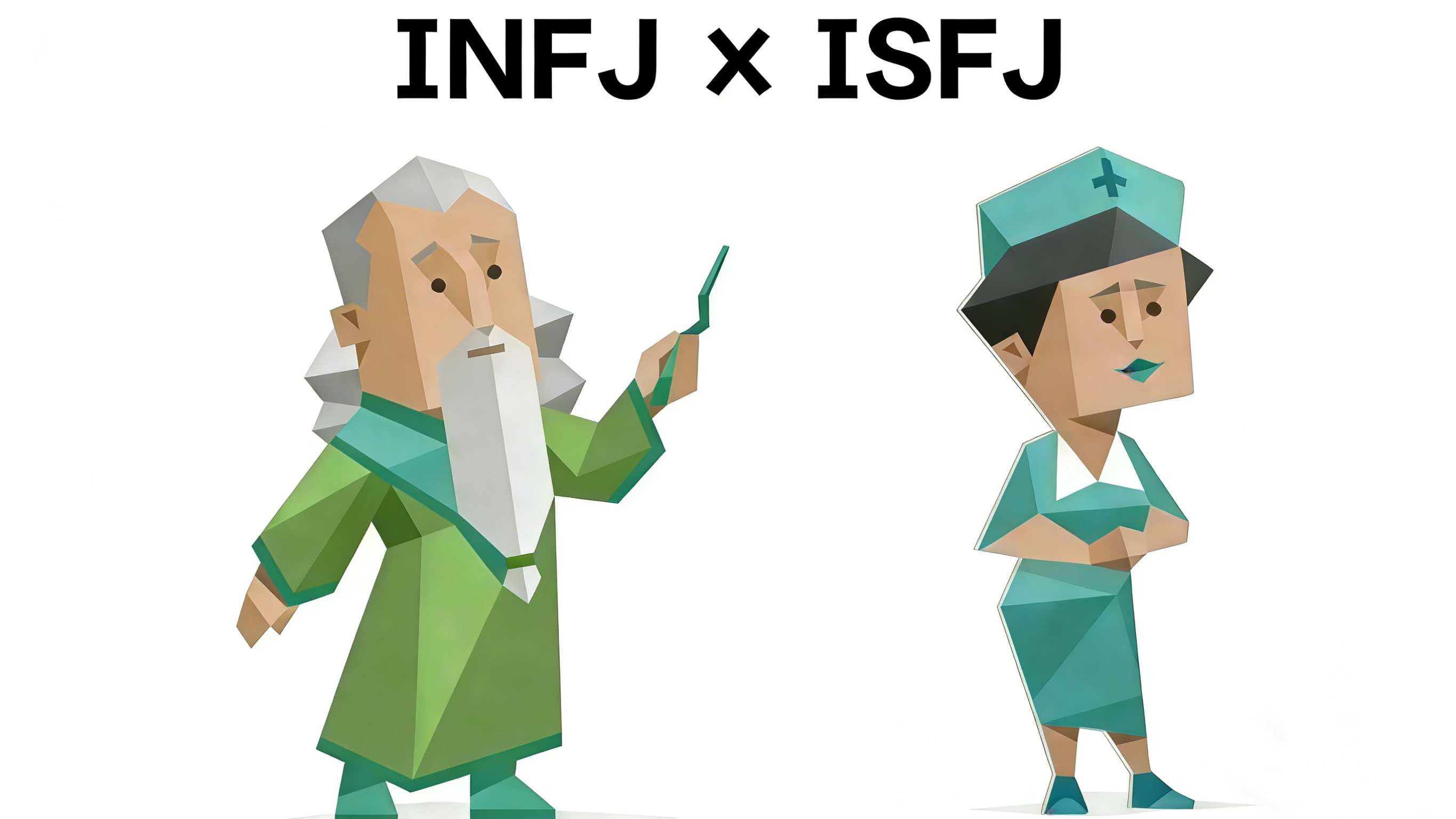 Image generated by AI
1. The Five Most Common Challenges in INFJ and ISFJ Relationships
1. Conversations About the Future
The most frequent misalignment between INFJs and ISFJs often occurs when discussing the future.
The future envisioned by INFJs is abstract and filled with possibilities. They might say, "I hope one day we can open a small bookstore, where we can read soul-stirring books together in the afternoon sunlight."
For INFJs, this is an expression of emotion and a longing for spiritual connection.
What the ISFJ hears, however, is the literal "opening a bookstore"-a concrete project requiring location selection, funding, and business licenses.
They might instinctively respond, "That would be quite costly, right? Our savings aren’t enough yet. And physical bookstores are really struggling these days."
The ISFJ isn’t trying to pour cold water on the idea; they’re simply thinking in the way they’re accustomed to-their brains are naturally wired to handle practical matters.
In this moment, the INFJ feels rejected, thinking, "They don’t understand my dream." The ISFJ feels misunderstood, thinking, "I was just analyzing rationally-why is that wrong?" Both are hurt, yet neither knows where the problem lies.
Observations from 2RedBeans Dating Consultants:
The INFJ needs to understand that the ISFJ’s pragmatism isn’t opposition but their way of engaging in the discussion. Next time, they could say, "I know this might not be realistic, but I just wanted to share this vision with you."
The ISFJ can practice responding, "That vision sounds beautiful-tell me more about it."
First, acknowledge the emotions, then discuss the practicalities.
2. Understanding Silence
Both INFJ and ISFJ are introverted and need alone time.
However, the reasons they "need alone time" point in entirely different directions.
The silence of an INFJ is an inward exploration. They might be pondering the meaning of life, processing the emotional impact of the day's experiences, or simply engaging in an inner dialogue. This silence is profound, like diving into the deep sea-the deeper you go, the darker it becomes, yet the richer it feels. Online jokes often describe the "Green Old Man" as unfathomable, and this is precisely why.
The silence of an ISFJ is an inward settling. They might be reflecting on a small event from the day, organizing tomorrow's to-do list, or simply needing a break from social interactions. This silence is substantial, like stacking layers of life, each layer solid and tangible.
The problem arises: when an INFJ falls silent, the ISFJ worries, "Are they unhappy? Did I do something wrong?"
When an ISFJ falls silent, the INFJ wonders, "Are they closing off their heart to me? Is there distance between us?"
Both interpret the other's silence through their own lens, and the more they think about it, the further apart they drift.
Advice from TwoRedBeans Dating Consultants:
Establish a small "silence signal." Agree that when one of you needs alone time, simply say, "I need to recharge for a bit" or "I’m going to zone out for a while." These few words can prevent a misunderstanding from turning into emotional exhaustion.
 Image provided by THE 5TH on Pixabay
3. Expressions of Love
The way INFJs express love is by creating deep spiritual connections. They write long letters for their partner, share music and words that touch the soul, and strive to enter the other person's most private inner world. For INFJs, love is "I understand you" and "You understand me."
The way ISFJs express love is by providing meticulous care. They remember all of their partner's preferences, quietly appear when needed, and use actions to prove "I am here." For ISFJs, love is "I do for you" and "You are being cared for." They are often called "little nurses" or "warm-hearted angels" online precisely because of this trait.
The problem lies in this: when an INFJ thoughtfully prepares a deep soulful conversation, the ISFJ might be more concerned with "Have you eaten yet?" When an ISFJ meticulously arranges a full day of attentive care, the INFJ might be more eagerly awaiting "Can you sit down and have a heartfelt talk with me?"
Both feel they are loving intensely, yet both feel the other hasn't received it.
2RedBeans Relationship Consultant Reminds: INFJs need to learn to see the deep affection behind ISFJs' actions-those daily acts of care are precisely their way of loving you. ISFJs, in turn, need to understand that the deep conversations INFJs crave are not a rejection of daily care, but another equally important form of connection. The best state is: you take care of my life, and I nourish your soul.
4. Handling Conflicts
Both INFJs and ISFJs dislike conflict, but their approaches to handling it are entirely different.
After a conflict occurs, INFJs need ample alone time to sort through their emotions. This process can last several hours, or even a day or two. They are not giving the silent treatment; rather, they are engaging in a complex internal dialogue, trying to understand what happened and what their true feelings are.
After a conflict occurs, ISFJs most desire to restore harmony as quickly as possible. They instinctively want to "solve the problem" and mend the rift through action. For ISFJs, a hug, a cup of hot tea, or a simple "it's okay" is the best way to reconcile.
Thus, a common cycle emerges: ISFJs are eager to make up, while INFJs need time alone. ISFJs feel that INFJs are using emotional withdrawal, while INFJs feel that ISFJs are pressuring them. Both end up feeling even more hurt.
2RedBeans Dating Consultants Offer Advice: You can establish a "conflict resolution agreement." For example: "Let's pause for now, each take two hours to cool down, and then come together over a cup of tea to talk." The INFJ gets the needed time, and the ISFJ gets a clear reconciliation point. This small agreement can resolve most of the anxiety around conflicts.
5. The Definition of "Depth"
The most fundamental difference between INFJs and ISFJs actually lies within the word "depth."
For INFJs, the depth they seek is in thought, emotion, and soul. They long to discuss questions with no definitive answers-the meaning of life, the nature of love, the mysteries of the universe. This kind of depth makes them feel alive and connected.
For ISFJs, the depth they experience is in relationships, time, and trust. They feel the profound sense of "no matter what happens, we are here for each other" through day-to-day interactions and year-after-year companionship. This depth is cultivated over time.
INFJs may sometimes feel that ISFJs are "not deep enough" because they never discuss those grand questions. ISFJs may sometimes feel that INFJs are "not grounded enough" because they are always chasing after intangible things.
But in reality, they are both pursuing depth in their relationship in their own ways. One grows upward, while the other roots downward.
2RedBeans Relationship Consultant Summary:
INFJs need ISFJs to teach them that depth can also be found in day-to-day companionship. ISFJs need INFJs to remind them that life is not just about daily necessities but also about poetry and distant horizons. When INFJs learn to appreciate the poetry in the ordinary, and when ISFJs begin to infuse meaning into the mundane, they truly understand each other.

Image provided by Alexa on Pixabay
II. Overcome These 5 Hurdles to Let Love Go Further
1. Establish Your Own "Translation Mechanism"
INFJs need to learn to translate abstract feelings into concrete language. For example, instead of saying, "I feel like something is missing between us," say, "Lately, our deep conversations have become less frequent, and I miss that feeling."
ISFJs need to learn to translate specific actions into emotional expressions. For example, instead of saying, "I cooked your favorite dish today," say, "I made this today because I wanted you to feel loved."
When both learn to express love in a way the other can understand, many misunderstandings naturally disappear.
2. Create Shared Rituals That Blend Both Traits
Combine both strengths to create unique rituals that belong to you both. For example, a monthly "Dream Dinner"-where the ISFJ prepares delicious food, and the INFJ prepares a topic worth discussing. Each showcases their strengths, nourishing one another.
Or a weekly "Gratitude Moment"-where the ISFJ shares warm moments of being cared for during the week, and the INFJ shares thoughts that touched their soul. The ISFJ grounds gratitude in reality, while the INFJ elevates reflection.
3. Respect Each Other's Completely Different Growth Paces
The INFJ needs to understand that not everyone is accustomed to abstract thinking. Give the ISFJ time to gradually approach your spiritual world at their own pace. When sharing, you can provide more context and ask, "How do you feel about this?" rather than expecting them to immediately grasp your depth.
The ISFJ needs to understand that the INFJ's craving for depth is not a rejection of you. Give them space to recharge in their own world and return to you with renewed energy. You don't need to become another INFJ; you just need to let them know you're always there.
4. Build a Bridge Between Dreams and Reality
The dreams of INFJs need ISFJs to bring them to life, and the realities of ISFJs need INFJs to illuminate them. This is not compromise, but complementarity.
If an INFJ dreams of opening a bookstore, an ISFJ can help with market research and financial planning; if an ISFJ hopes to improve family life, an INFJ can bring more creative ideas for income or lifestyle.
Turn your differences into resources for solving problems together, rather than reasons to blame each other.
5. Conduct Regular "Relationship Check-ups"
Since both parties are not adept at directly expressing dissatisfaction, regular emotional check-ins are especially important. Set aside a relaxed weekend evening each month to gently discuss:
"What have we done particularly well lately?"
"Is there anything that has made you feel a bit uncomfortable but hasn’t been brought up?"
"What would you most like us to do together in the coming month?"
Start with "we" instead of "you," and use a tone of curiosity rather than accusation. This small ritual can resolve many minor issues before they escalate into major conflicts.

Image provided by Pexels on Pixabay
III. Final Thoughts
The most defining characteristic of the INFJ and ISFJ pairing is this: you are always loving each other in different ways.
The INFJ wants to know, "Do you understand me?" while the ISFJ asks, "Do you see me?"
In truth, you're not asking for two different things. What the INFJ seeks-to be understood-manifests for the ISFJ as "I remember all the little things about you." What the ISFJ desires-to be cherished-is expressed by the INFJ as "You are the only one I'm willing to open my heart to."
An INFJ once shared a story online about her ISFJ boyfriend. During a period of depression when she didn't want to talk, he never pressed her. But every morning she woke up, there was a bowl of warm porridge on the table with a small note beside it saying, "The sunshine is beautiful today" or a hand-drawn smiley face. She said, "He doesn't understand my emotions, but he knows how to be there for me."
This is the truest form of the INFJ and ISFJ dynamic. You don't need to become like each other; you just need to recognize that the other person is consistently giving you the answer you seek, in their own way.
Matchmaking consultants at 2RedBeans have observed that INFJs and ISFJs often end up saying the same thing: "So it wasn't that they didn't love me; they were just loving me in a way I couldn't recognize."
That's why we often tell this pairing: You don't need to tune into the same frequency; it's enough that you can listen to the same song together.
One is responsible for melody, the other for rhythm. One makes the song sound beautiful, the other makes it singable.
Next time you feel out of sync, don’t rush to ask, "Does he not understand me?" Try switching to: "If it were him, how would he express love?"
Once you understand this, you’ll be in harmony.
 Image provided by Pexels on Pixabay
Cover Photo generated by AI.
Original article in simplified Chinese. Translated by AI.