2RedBeans
Is Being Good at Love Actually a Skill You Can Learn? 5 Books That Say Yes
A note from us: No skipping the homework — these five books are required reading. Already read one? Raise your hand in the comments and tell us what stuck with you.
A lot of people treat finding love as luck. But the ones who actually find it — and keep it — tend to change in similar ways: they learn to listen instead of vet, to say what they mean instead of guess, to get their own house in order first. Which points to one thing: love is an ability, and abilities can be learned.
The five books below are the ones we most often recommend to members just starting out. Each tackles one essential skill — becoming a better you, expressing love, communicating well, fighting well, and getting the big conversations out in the open — and every one comes with a simple analogy so you can see what it's about at a glance.
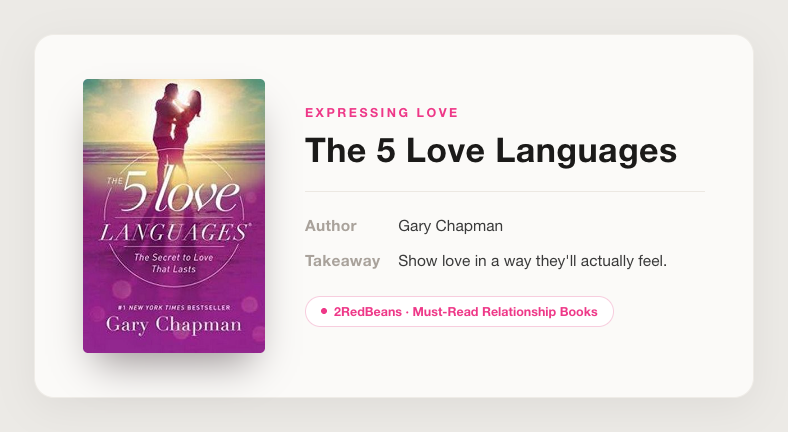
1. The 5 Love Languages — The Romance You're Offering May Not Be the One They Want
You remember every anniversary. You stay up late picking out the perfect gift. You quietly handle all the chores. And then one day they say, "I don't feel like you care about me." You're hurt and baffled: I've done all of this — what more is there?
Gary Chapman spent decades counseling couples, and he landed on a plain but painful truth: everyone receives love on a different "channel." He sorts love into five languages — words of affirmation, quality time, receiving gifts, acts of service, and physical touch.
Think of it this way: You keep saying "I love you" in English, but they only understand French. No matter how heartfelt you sound, it doesn't land. Love languages are your native tongues.
So many relationships where one person is clearly trying hard but never feels appreciated get stuck right here: the love was given — it just wasn't delivered to the right channel. Once you understand this, a lot of past, inexplicable disappointments suddenly make sense. It wasn't a shortage of love. It was the wrong language.
In one line: Speak the right love language and every day feels like the honeymoon phase. Speak the wrong one and all your effort lands like a punch into cotton.
One thing you can use today: Pick a relaxed moment and ask your partner, "When do you feel most loved by me?" Then turn it around and ask yourself which language matters most to you. The answers are often surprising.
Who it's for: Anyone in a relationship, or anyone who wants to keep one fresh. The Chinese edition is an easy read — you can finish it in two or three evenings. A perfect starter self-help book for tending a relationship.
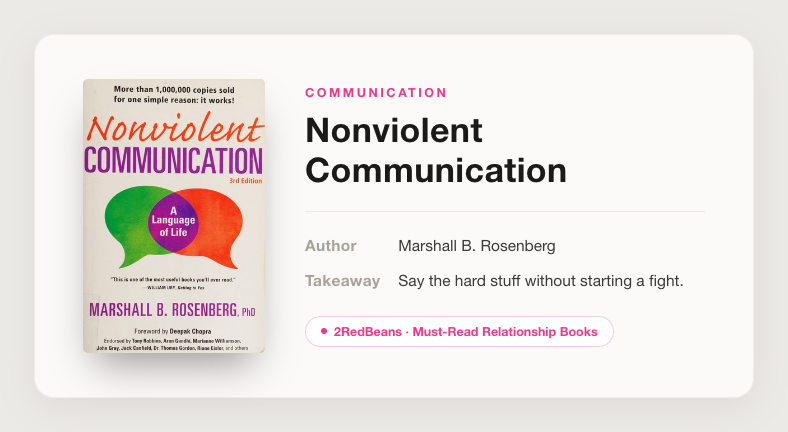
2. Nonviolent Communication — Same Issue, Different Words, No Fight
"Why did you leave the dishes in the sink again?" — it starts as nothing, and five minutes later it's escalated into dredging up old grievances, slammed doors, and three days of silence. Afterward even you're confused: what were we actually fighting about?
What grinds a relationship down, bit by bit, usually isn't the big stuff — it's the barbed little remarks of everyday life. Marshall Rosenberg reminds us that blame, sarcasm, labeling, and offhand judgment are forms of "verbal violence," and the wounds they leave can be harder to heal than physical ones. This book doesn't teach scripts. It teaches a simple sequence: observation, feeling, need, request.
Think of it this way: The same sentence can be hurled like a rock or passed like a ball. Throw the rock and they'll duck or throw one back. Pass it gently and they can actually catch it.
Look at two ways of saying the same thing:
- ❌ "Why are you always so selfish? You don't care about this home at all."
- ✅ "You've worked late three nights this week (observation). I've felt a little lonely at home by myself (feeling). I'd really love more time together, just the two of us (need). Could we keep one weekend night for each other? (request)"
The difference: the first attacks the person; the second talks about the situation and your own needs. Attack a person and they fight back. Let a need be heard and it can be met.
In one line: We think we're communicating. A lot of the time we're just venting.
One thing you can use today: Next time "you always…" or "you never…" is about to fly out of your mouth, pause one second and swap it for "I noticed… I felt… I'm hoping…"
Who it's for: Anyone who ever comes into conflict with another human — so, everyone. This isn't just for couples; it pays off for a lifetime with parents, friends, and coworkers too.
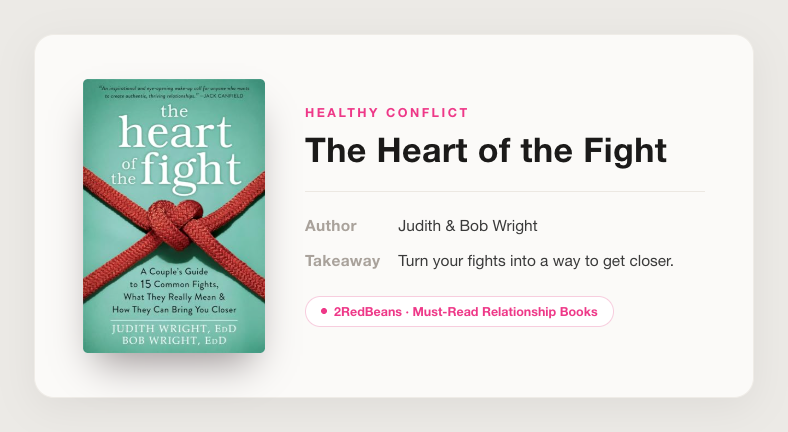
3. The Heart of the Fight — There's No Couple That Doesn't Fight, Only Couples Who Don't Know How To
You start arguing over something so small you can't even remember what it was, and it spirals until you're hauling out grudges from three years ago. Once you cool down you think: we clearly love each other — so why do we turn into enemies the moment we fight?
If Nonviolent Communication teaches you how to say things well, this book deals with what happens after the words have already gone wrong and the fight is already on — how to make conflict a way to get closer instead of a way to wound each other. The authors sort everyday arguments into 15 types, and find that the trigger for almost any fight is just the surface. Underneath sit one or both partners' "unmet longings" and "unhealed old wounds."
Think of it this way: A fight is like a fever. The fever itself isn't the illness — it's a signal that something's wrong. Your job isn't to curse the fever; it's to follow it to wherever the body is actually sick.
So the book's most counterintuitive line is this: "A fight is a prime opportunity to rewire the brain, because unresolved knots surface and finally get worked through." Once you stop seeing a fight as a failure of the relationship and start seeing it as a chance to witness what each of you truly cares about, you stop burning each other out for nothing.
In one line: How you treat your fights decides the future of your relationship.
One thing you can use today: Next time a fight ends, don't rush to move on. Each of you ask yourself: "What was I really upset about back there?" The answer often has nothing to do with the thing you fought over.
Who it's for: Couples who keep blowing up small things into big fights, or who freeze each other out the moment conflict starts. It'll help you stop fearing conflict and turn every argument into a chance to understand each other better.
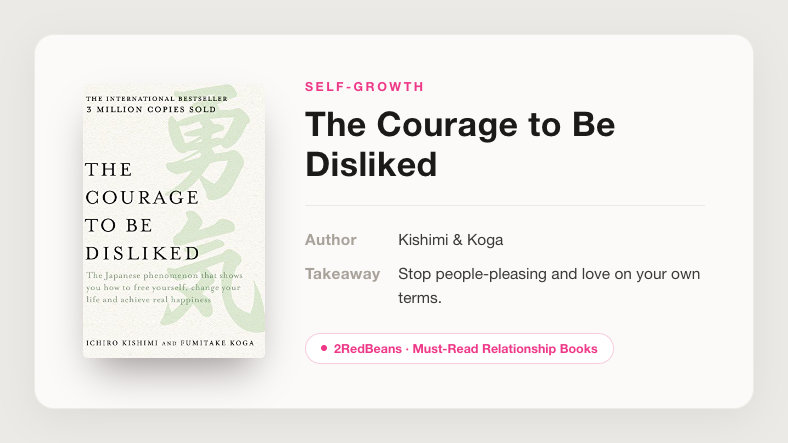
4. The Courage to Be Disliked — Make Peace With Yourself First, Then Love Without Groveling or Pride
They haven't replied in a while, and you've already played out an entire breakup drama in your head. You rewrite a text five times before sending it, terrified of seeming clingy. Something genuinely bothers you, but you smile and say, "It's fine."
If you're always this anxious and insecure in relationships, the problem may not be the other person — it may be that you haven't made peace with yourself yet. This book, written as a dialogue and grounded in Adlerian psychology, offers one especially useful tool: "separation of tasks." What others think is their task; how you choose to act is yours.
Think of it this way: What other people think of you is like the weather in their backyard — not yours to control. The only yard you can tend is your own. Once you draw that line clearly, your mind gets a lot lighter.
So much of the inner churn in relationships comes from tangling these two things together: people-pleasing so they won't dislike you, taking on all of their emotions as your own, never daring to voice what you actually need. The moment you're brave enough to "be your real self, even at the risk of being disliked," real happiness becomes possible — you stop trading flattery for love and start meeting someone as your whole self. And here's the funny part: people like that tend to be the most attractive of all.
In one line: The courage to be disliked isn't about making people dislike you. It's about no longer letting other people's eyes run your life.
One thing you can use today: Next time one remark from your partner sends you spiraling for hours, ask yourself: is this my task, or theirs?
Who it's for: Anyone who slips into people-pleasing, gets stuck in their own head, or constantly feels "not good enough" in relationships. You'll come away living more at ease — and ease itself is magnetic.
5. Eight Dates — Settle the Unavoidable Big Stuff Before It Turns Into a Fight
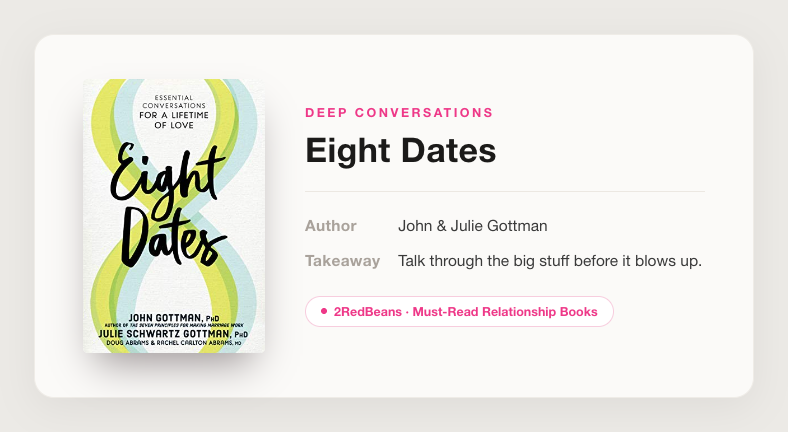
Everything between you is great — except for a few topics you both veer away from the second they come up: whether to have kids, how to handle money, whose family to visit for the holidays, whether to live with parents. You put it off and put it off, until one day you blow up over something you "should have talked about ages ago."
Drawing on forty years of research from their world-famous "Love Lab," John and Julie Gottman break the topics that make or break a relationship into 8 dates: trust, conflict, sex, money, family, fun and adventure, growth and spirituality, and dreams. Each one comes with specific questions and ways to talk through them — so instead of dryly asking "how many kids do you want," you ask, "What was the mood like in the home you grew up in? Do you want ours to feel like that, or the opposite?"
Think of it this way: Being together is like two people road-tripping in one car. Far better to agree on the destination early than to reach a fork in the road and discover one of you wants to go east and the other west.
The book's cleverest move is turning a "serious negotiation" into a "fun, low-pressure date." Most disagreements aren't actually scary. What's scary is never having talked about them — each of you just assuming the other "should already know."
In one line: For the things that matter, don't wait for them to become a fight. Pick an evening and talk them through on purpose.
One thing you can use today: Choose a topic the two of you have never really discussed (say, "how each of us thinks about money"), set aside one evening for just that, ask "why" a lot, and don't rush to conclusions.
Who it's for: New couples who want to understand each other more deeply — and longtime partners who want to shore things up. You can finish it in two evenings, and if your English is so-so, the Chinese edition (《爱的八次约会》) works just as well.
Why Read These Five Together
Each book is great on its own, but lined up together they form a complete arc of growth:
- The Courage to Be Disliked gets you settled within yourself first — a steady person doesn't cling and second-guess in love;
- The 5 Love Languages teaches you to place love directly in your partner's hands, so your effort is actually felt;
- Nonviolent Communication helps you say things well day to day, so you don't push people away;
- The Heart of the Fight teaches you, when a real fight breaks out, how to turn conflict into a chance to understand each other better;
- Eight Dates walks you through the unavoidable big stuff in advance — so the two of you have not just the passion of falling in love, but the quiet understanding it takes to stay.
Settle yourself → express love → talk well → fight well → talk through the big things. You don't have to read them all in one go. Start with whichever one hits closest to where you are right now. Make it around the loop and you'll find yourself meeting love with far more calm than before.
One Last Thought
Reading won't get you a partner by tomorrow. But it will, little by little, change the way you see yourself and your relationships — and that kind of change is often worth more than scrolling through a hundred more profiles or going on ten more dates. We've watched so many people start with one small shift in perspective and slowly walk into something good.
These five are the starting point we recommend most. If you finish them and want to talk through your own situation — or you're not sure which one fits where you are right now — you're welcome to book a one-on-one matchmaking consultation with 2RedBeans. Our consultants will draw on your own experiences and help you turn the wisdom in these books, bit by bit, into an ability that's truly yours.
👉 Book a one-on-one matchmaking consultation with 2RedBeans →
Cover image generated by MiniMax