2RedBeans
Vancouver's Chinese Singles, by the Numbers: Are There Really No Men Good Enough?
"Vancouver women are educated, accomplished, and have their lives together. They just can't find a man who measures up." If you've spent any time in Metro Vancouver's Chinese community, you've heard some version of this, usually followed by: "All the good guys moved south to Seattle or the Bay Area." So we ran the numbers, using the Canadian census plus a full year of anonymized platform data. Here's what we found: among single Chinese Canadians aged 25 to 34, men outnumber women, and among singles who are actively looking, plenty of the men are highly educated. The real issue is that a big share of Vancouver women's attention isn't focused on Vancouver at all.
This is the latest stop in our regional data series, after the Bay Area and New York. Methodology is at the end.
How many Chinese Canadians live in Vancouver?
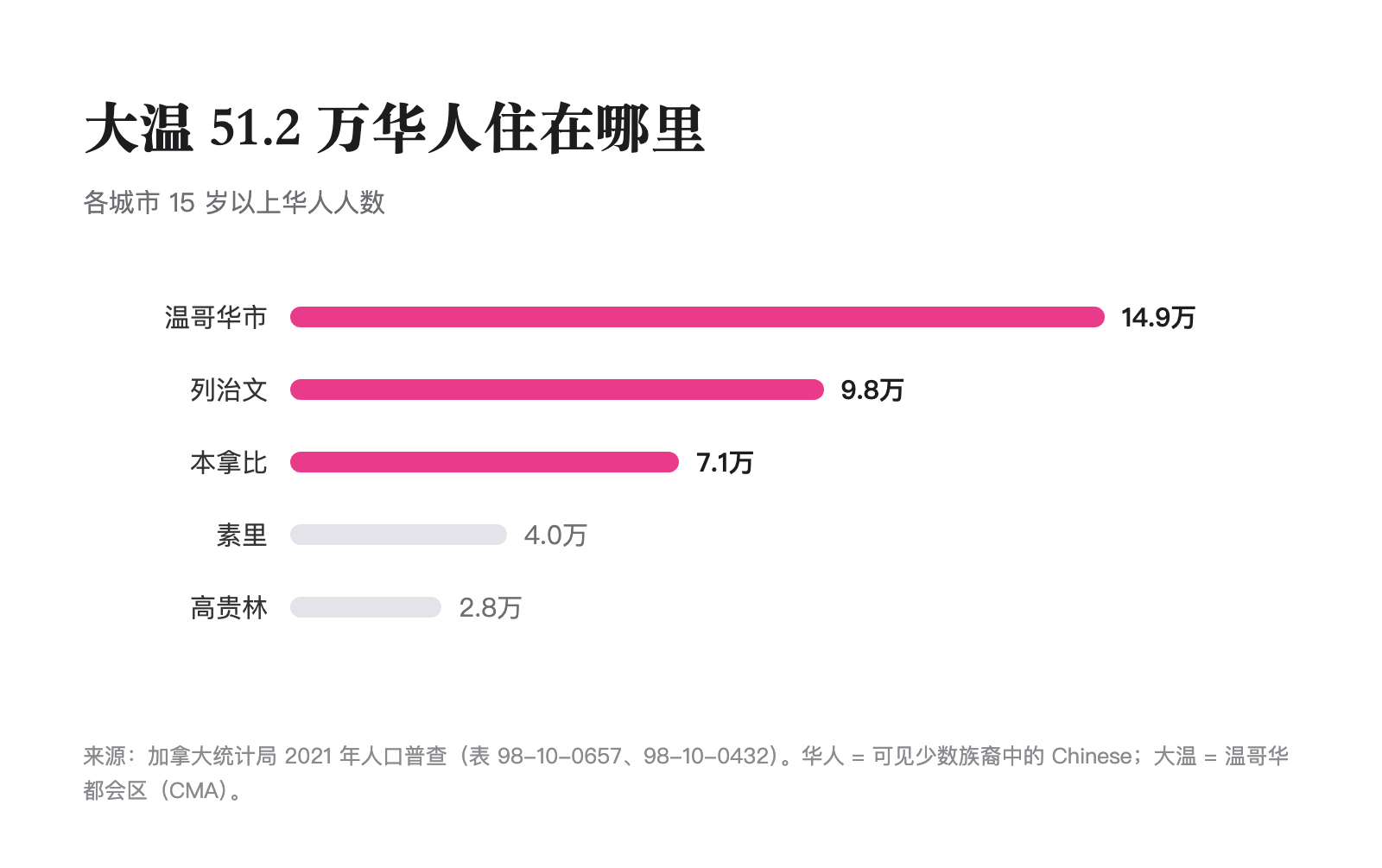
According to the 2021 Census, Metro Vancouver is home to about 512,000 Chinese Canadians, or 19.6% of residents. That's close to 1 in every 5 people, roughly double the Bay Area's share (about 1 in 10). Toronto has more Chinese residents in absolute terms (around 680,000), but they make up only 11% of the city.
Where Chinese residents aged 15 and up live:
- City of Vancouver: about 149,000
- Richmond: about 98,000
- Burnaby: about 71,000
- Surrey has about 40,000, and Coquitlam about 28,000
"More women than men" is only half true
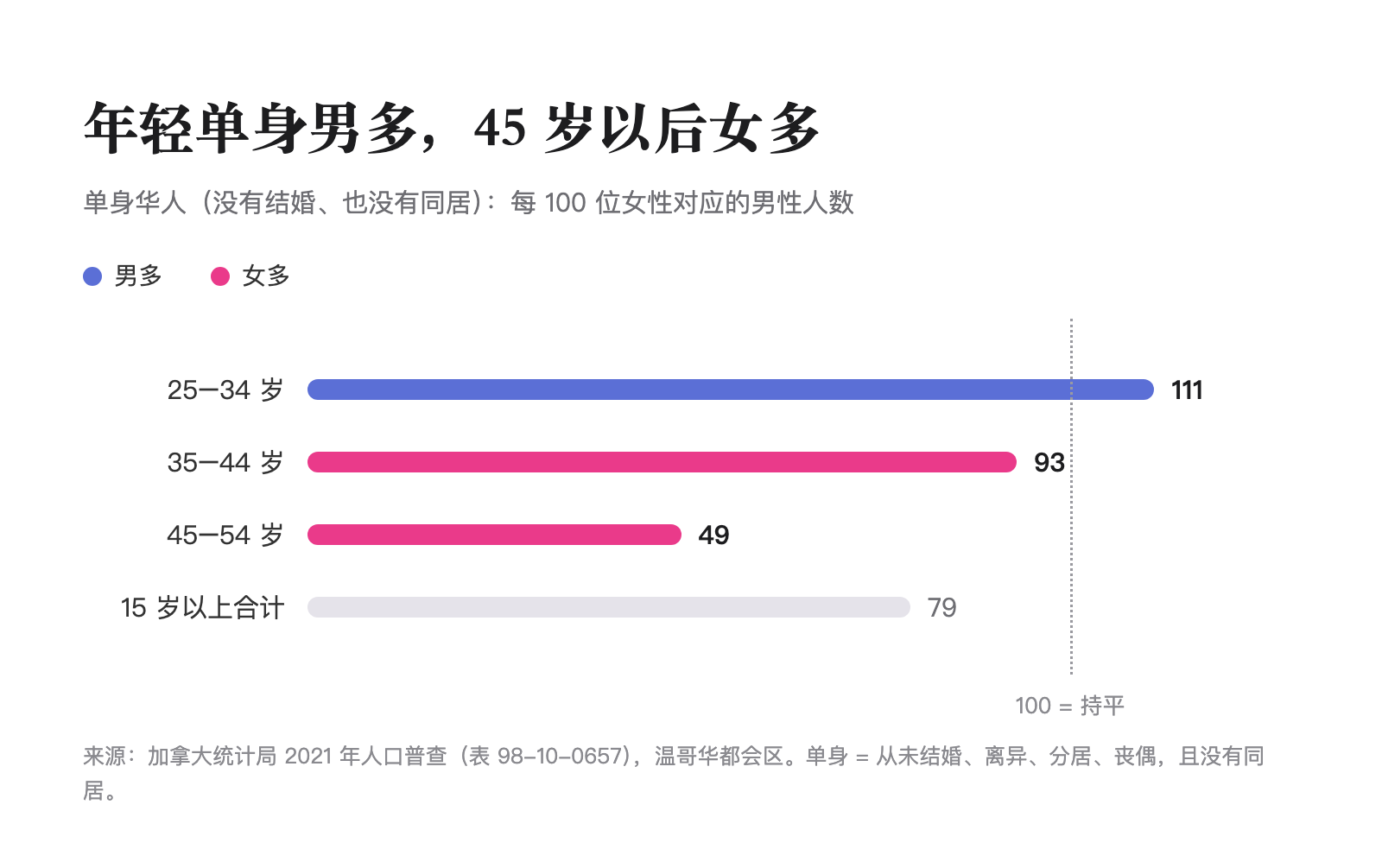
Across all ages, Vancouver has about 79,000 Chinese men and 100,000 Chinese women aged 15+ who are neither married nor living common-law. That's 79 men for every 100 women. This is where the "there just aren't enough men" story comes from.
Break it down by age, though, and you get a very different picture:
| Age | Single men | Single women | Men per 100 women |
|---|---|---|---|
| 25–34 | 24,000 | 21,700 | 111 |
| 35–44 | 8,200 | 8,800 | 93 |
| 45–54 | 5,000 | 10,300 | 49 |
Between 25 and 34, single Chinese men actually outnumber single women. Count only people who have never been married, and the ratio is 114 men per 100 women at 25–34 and 115 at 35–44. Nearly all of the female surplus shows up after 45, and at 45–54 the ratio drops to 49. Even then, never-married men and women in that bracket are close to even (2,900 vs. 3,400). The extra single women are mostly divorced, separated, or widowed.
So when your parents' generation says "Vancouver has too many women," they're mostly describing their own generation. These figures cover single people only. Married and common-law couples aren't counted. If you're young and dating, there's no shortage of men, at least on headcount.
So why does it still feel so hard for women?
Education: there are plenty of educated single men
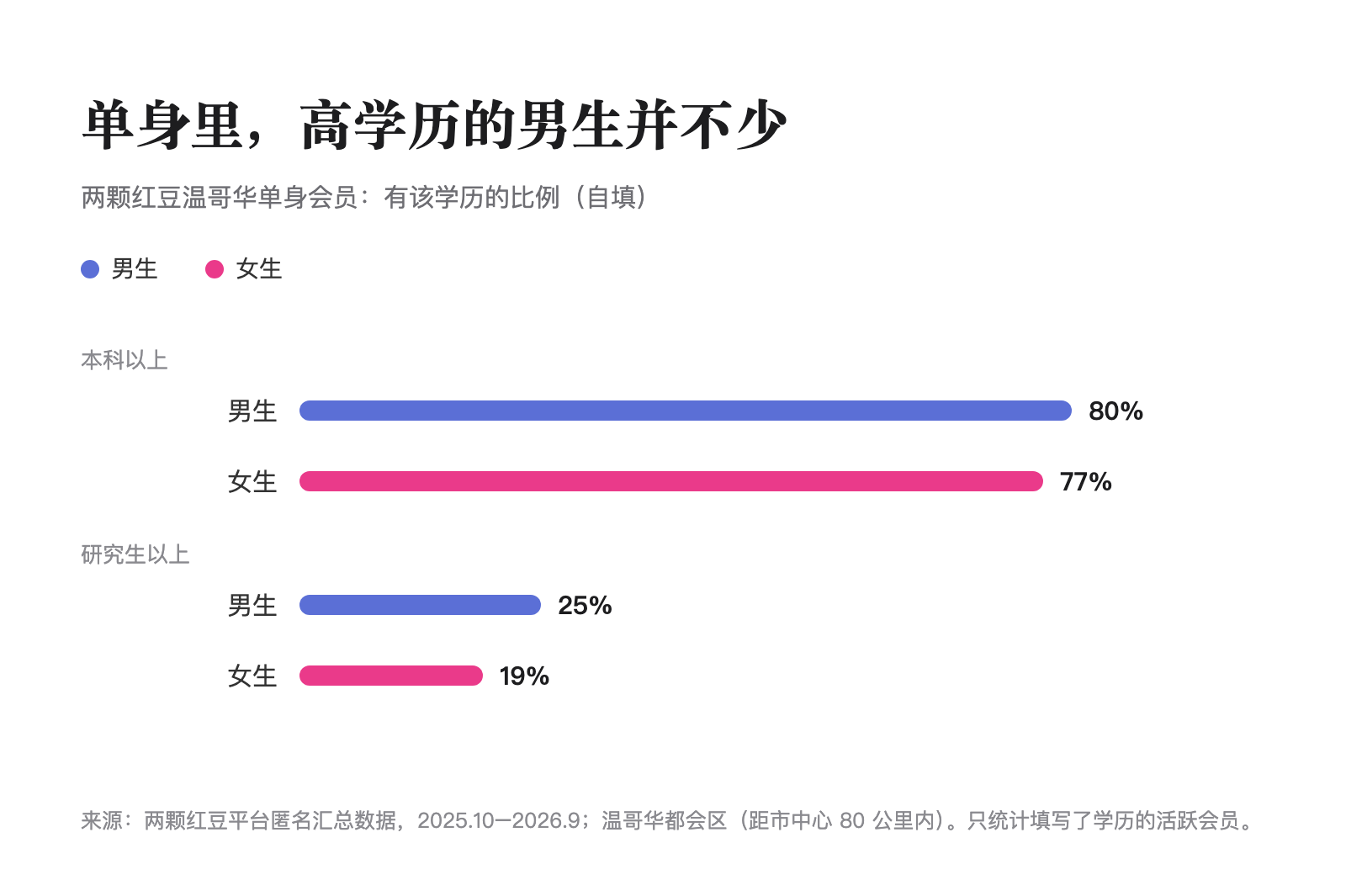
To test "women are more educated and the men can't keep up," you have to look at singles, not the whole population. Everyone on 2RedBeans is single and actively looking, and members list their education on their profiles.
Among Vancouver's single members, 80% of men have at least a bachelor's degree, compared with 77% of women. For graduate degrees it's 25% of men and 19% of women. Educated single men aren't any scarcer than educated single women. And because the app skews male to begin with, there are about 155 single men with a bachelor's degree or higher for every 100 single women who match them.
The pattern holds in other big cities too. In Toronto, the Bay Area, and New York, single men on the platform are more likely than single women to hold at least a bachelor's.
So whatever "no one measures up" means, on education alone it isn't a supply problem. The educated single men exist. The problem is somewhere else.
On the app: lots of men, not many likes
On 2RedBeans, the ratio among active members aged 25 to 44 in Vancouver is 190 men for every 100 women — a heavily male crowd. The app reflects who's actively looking, and in every city that group skews more male than the census does.
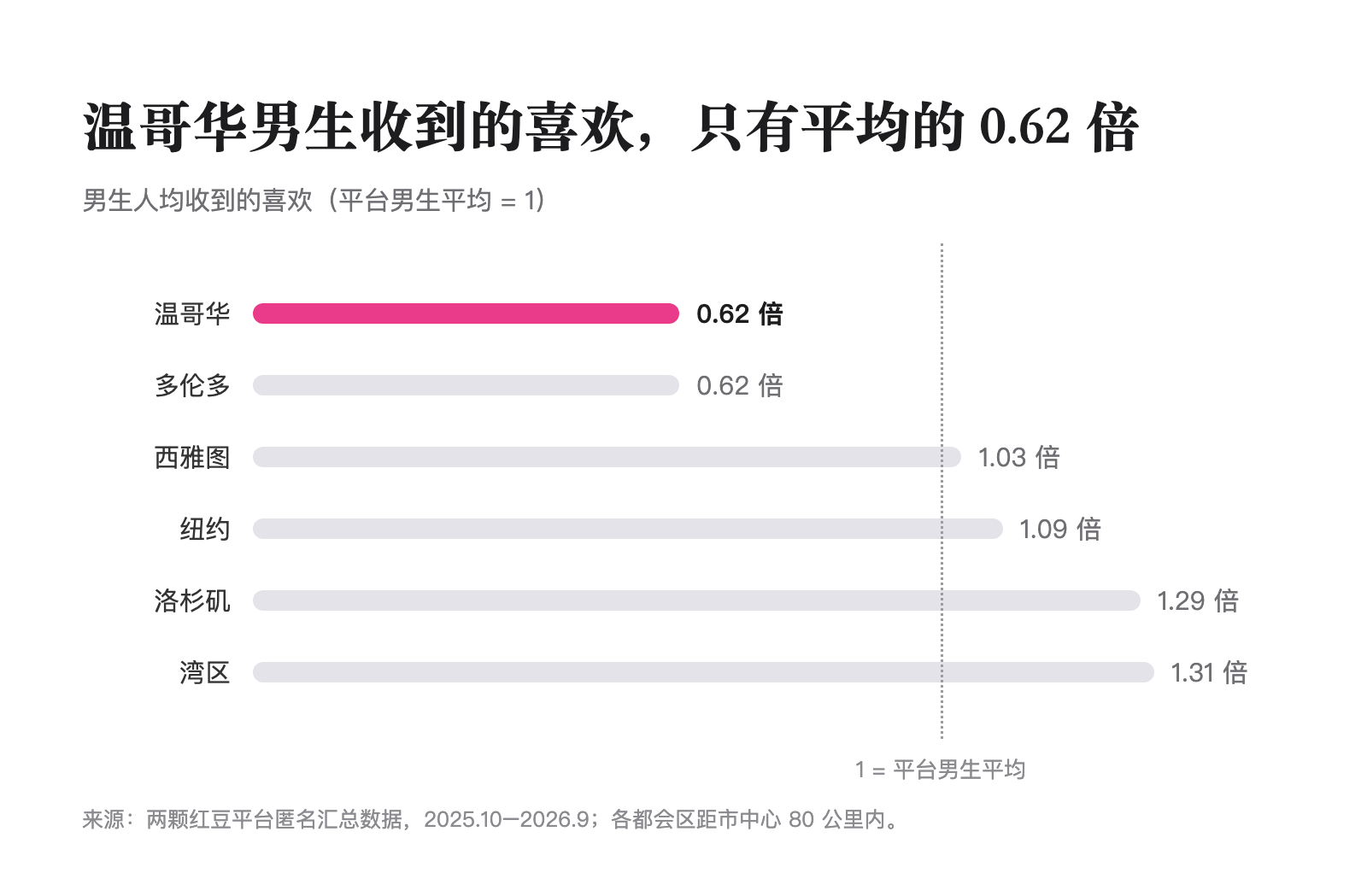
With that many men, attention gets spread thin. The average Vancouver man receives just 0.62x the likes of the average man on the platform, the same as Toronto. In the Bay Area and Los Angeles, men get about 1.3x, in New York 1.1x, and in Seattle 1.0x. Women in Vancouver get liked by 23% of the people who view their profile. For men, it's 14%.
30–50% of women's likes go to the US
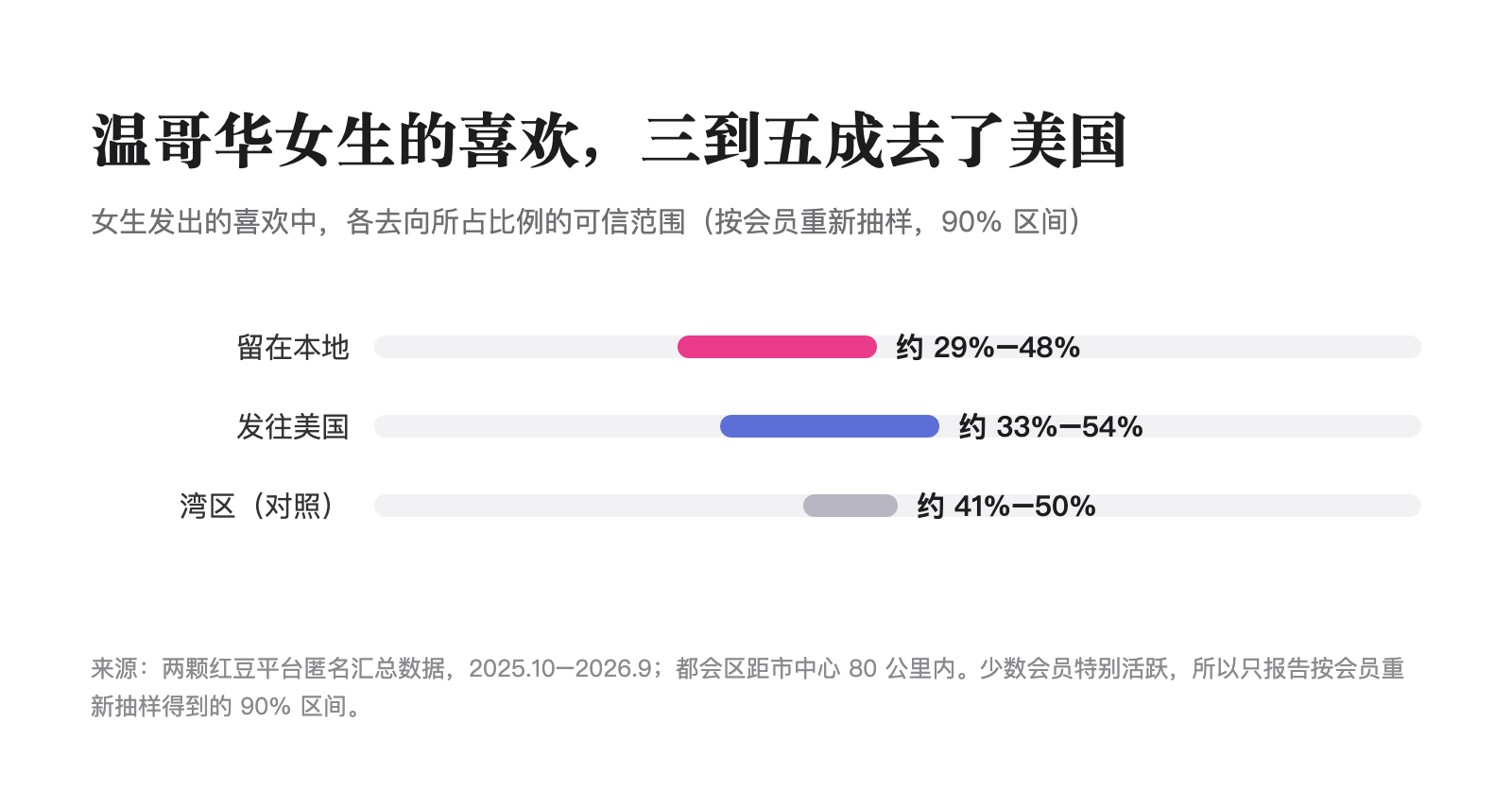
So who are Vancouver women liking? Only 30–50% of their likes stay in Vancouver. Another 30–50% go to the US, and some of the rest go to Toronto.
(Why a range instead of one number? A small handful of very active members can push the share up or down by several points on their own. We re-estimated it by resampling members and report only the range that holds up.)
Most of the US share goes to Los Angeles and the Bay Area. Interestingly, Seattle gets almost none, even though it's the closest city and skews male. So it's less "chasing a Seattle software engineer" and more looking toward California.
Very little flows the other way. Men in the Bay Area, LA, and New York send only about 2% of their likes to Vancouver. Seattle men send a bit more, around 5%.
Are these women actually planning to move, or is the grass just looking greener a few hundred miles south? Platform data can show what's happening, but not why. Put the census and the app side by side, though, and the picture is clear. Young single Chinese men aren't in short supply, and educated men who are actively looking aren't either. But women's attention drifts south and east, and the men who stay local get far less of it than men in the Bay Area, LA, New York, or Seattle.
Women say they can't find anyone who measures up. Men say nobody even looks at them. They're in the same city. They just keep missing each other.
About the data
- Census: Statistics Canada, 2021 Census of Population. "Chinese" refers to Chinese as a visible minority group. Population and marital status come from Table 98-10-0657 (population in private households). "Single" means not married and not living common law, which includes never married, divorced, separated, and widowed. "Never married" is noted separately. Metro Vancouver means the Vancouver Census Metropolitan Area (CMA). The census measures marital status, not dating status.
- 2RedBeans platform data: Active members are real, visible members who were active in the past 90 days and have a photo and birthdate on their profile. Likes and like-backs cover the 12 months ending October 2026. Metro areas include everything within 80 km of the city center. Likes received per man are indexed so the platform-wide average for male members equals 1. Like rate = likes received ÷ people who viewed the profile. Like-back rate = the share of likes that were returned. Education is the highest level members report on their profiles, counted only for members who filled it in (about 80%), across all ages. Only opposite-sex interactions between real accounts are included. This article reports only ratios and percentages.
If your profile keeps getting views but no responses, it might be time for a second pair of eyes. 2RedBeans' Profile Concierge service pairs you one-on-one with a senior matchmaking consultant who'll help fine-tune your photos, your bio, and how you present yourself. And if you'd rather start meeting Chinese singles in Vancouver right away, head to Vancouver Chinese Singles.
Frequently Asked Questions
Q: How many Chinese people live in Vancouver?
According to Canada's 2021 Census, Metro Vancouver has about 512,000 Chinese residents, or 19.6% of the population, roughly 1 in 5 people. The cities with the most Chinese residents aged 15+ are the City of Vancouver (about 149,000), Richmond (about 98,000), and Burnaby (about 71,000).
Q: Are there really more Chinese women than men in Vancouver?
According to Canada's 2021 Census, across all ages there are more single Chinese women than men: 79 men for every 100 women aged 15+. But nearly all of that gap appears after age 45 (49 men per 100 women at 45–54). Among singles aged 25 to 34, men actually outnumber women, 111 per 100, and 114 per 100 when counting only the never-married.
Q: On dating apps, are single Chinese men in Vancouver less educated than the women?
No. According to 2RedBeans platform data, 80% of single male members in Vancouver have at least a bachelor's degree, compared with 77% of women. For graduate degrees it's 25% and 19%. Platform data reflects singles actively dating online, and education is self-reported.
Q: On dating apps, who are Vancouver's Chinese women liking?
According to 2RedBeans platform data, about 30–50% of the likes Vancouver women send stay in Vancouver, another 30–50% go to the US (mainly Los Angeles and the Bay Area), and some go to Toronto. Platform data reflects people actively dating online. It doesn't tell us how many people actually move.
Cover image generated by AI