2RedBeans
Dating in the Bay Area by the Numbers: Are Engineers Really the Catch?
Open a dating app in the South Bay and scroll for a minute. Software engineer. Senior software engineer. Engineering manager. Staff engineer at a company you've definitely heard of. In the platform data we analyzed for this piece, more than one in three active men in the South Bay lists engineering as his job.
So here's the question every Bay Area single eventually asks: when everyone's an engineer, is "engineer" still a selling point? We pulled the latest Census microdata and a year of anonymized platform data to answer it — and to put real numbers on the other thing everyone here complains about, the gender ratio.
1. How Many Chinese Singles Are There in the Bay Area?
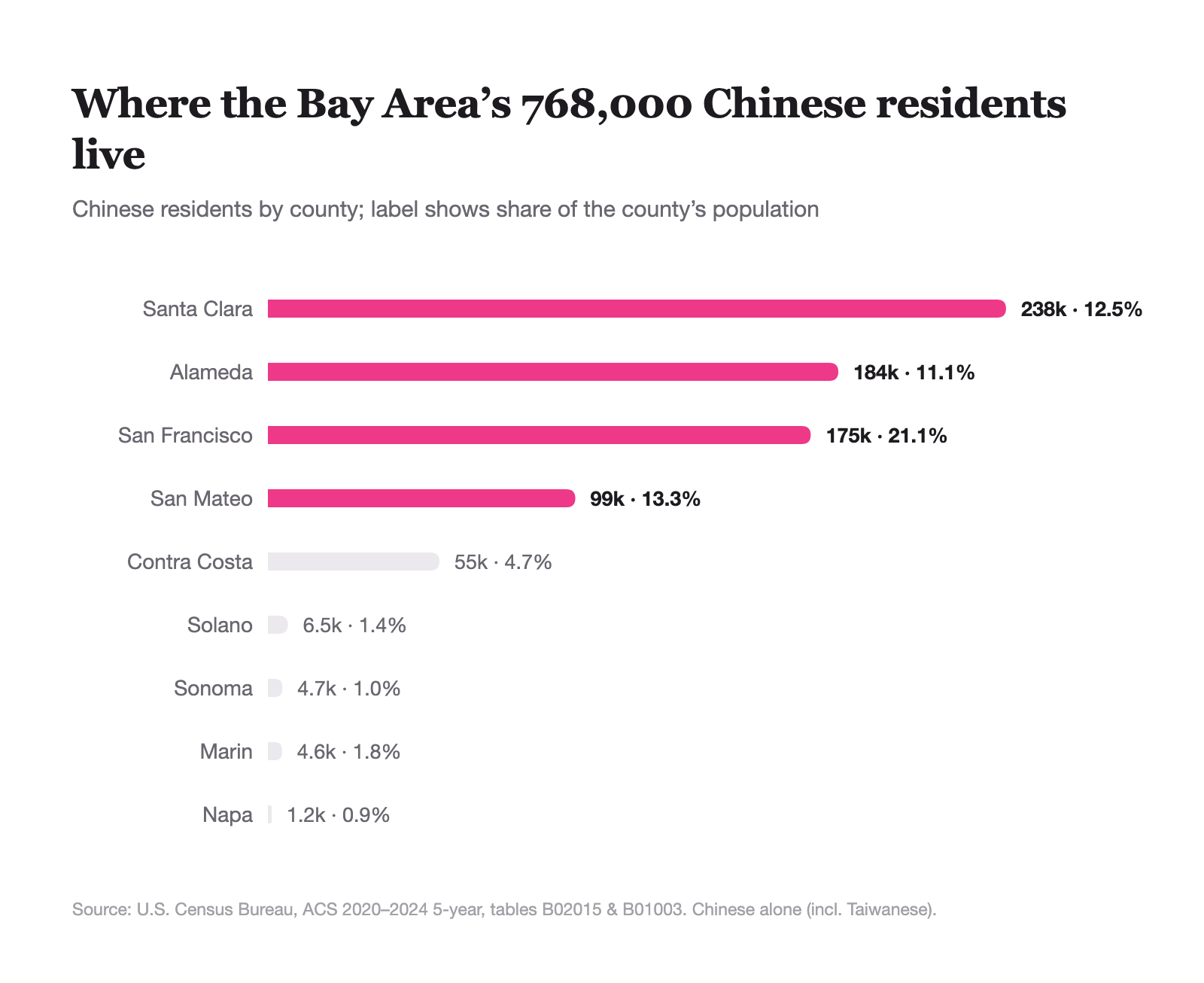
The nine-county Bay Area is home to about 768,000 Chinese residents — roughly one in ten people. In San Francisco it's one in five. Four counties — Santa Clara, Alameda, San Francisco and San Mateo — hold about 90% of them.
Among Chinese adults aged 25 to 44 who aren't married (never married, divorced, separated or widowed), there are about 62,000 men and 51,000 women. That's 121 men for every 100 women — roughly five single men for every four single women.
One honest caveat up front: the Census counts marital status, not relationship status. "Unmarried" includes people who are living with a partner or happily dating. The real pool of people who are looking is smaller on both sides, but there's no reason to think the ratio flips.
2. The South Bay Is the Most Lopsided
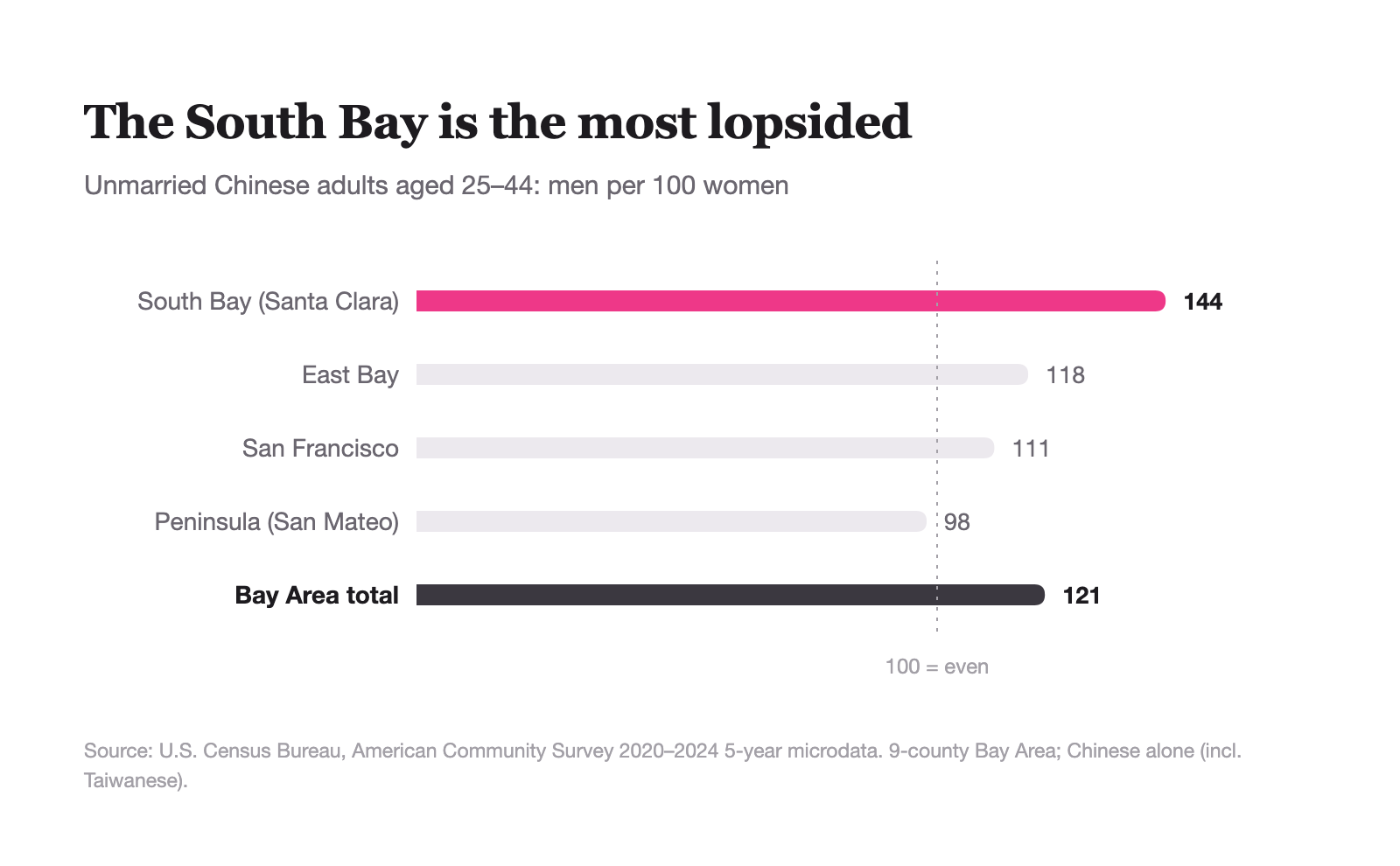
The ratio isn't the same everywhere. For unmarried Chinese adults aged 25 to 44:
- South Bay (Santa Clara County): 144 men per 100 women — close to three men for every two women
- East Bay: 118
- San Francisco: 111
- Peninsula (San Mateo County): 98 — the only part of the Bay where single women slightly outnumber single men
The pattern follows the jobs. Santa Clara County is where the big tech campuses are, and the population mix tracks the hiring mix. That has a practical consequence we'll come back to: how far you're willing to drive changes the ratio you're dating in.
3. The Extra Single Men Are in Tech
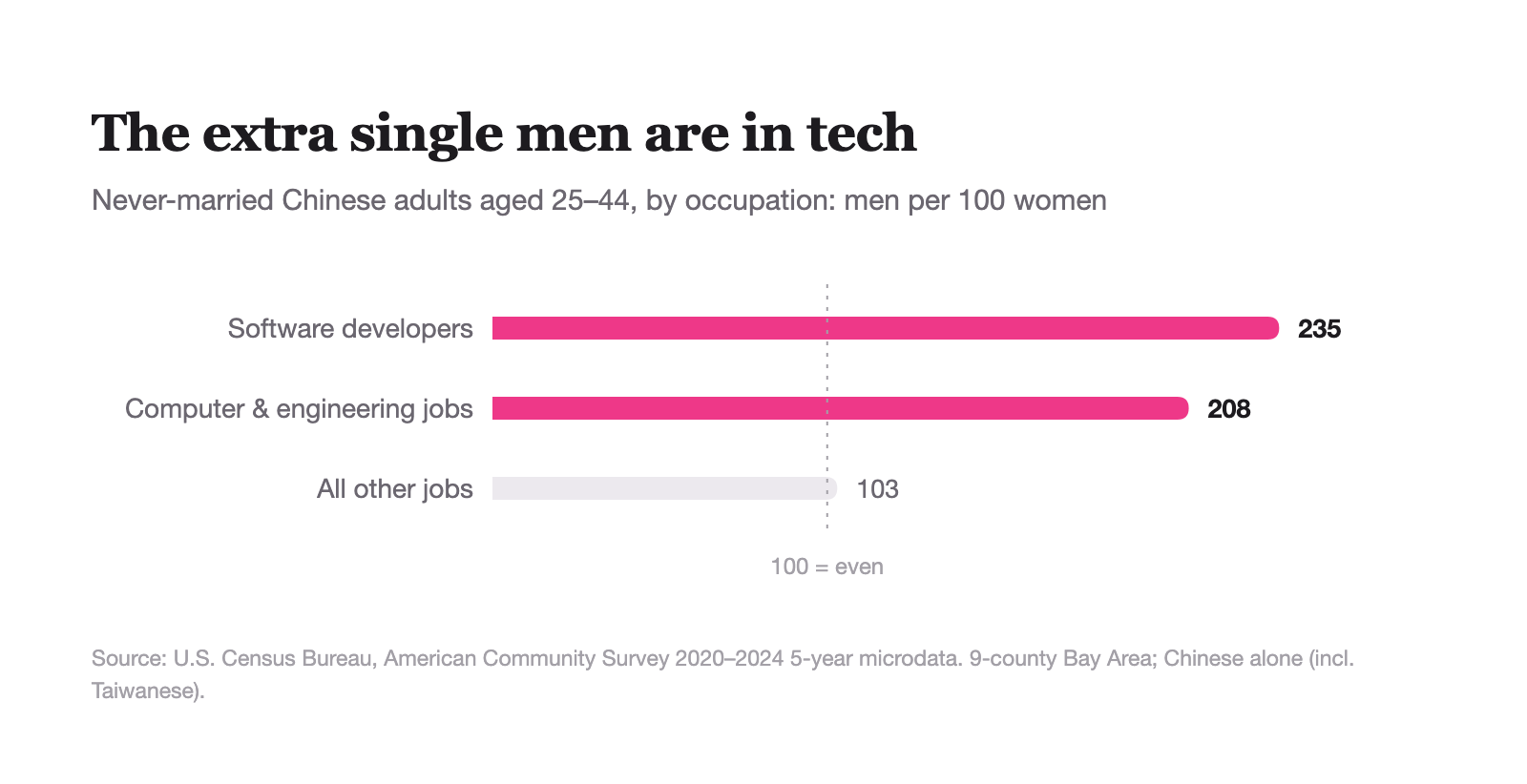
This is the number that explains the whole Bay Area dating market. Among never-married Chinese adults aged 25 to 44:
- Software developers: 235 men per 100 women
- All computer and engineering jobs: 208 per 100
- Everyone outside tech: 103 per 100 — essentially even
In other words, the Bay Area's "too many men" problem is almost entirely a tech-industry problem. Outside of computer and engineering jobs, single Chinese men and women are at parity.
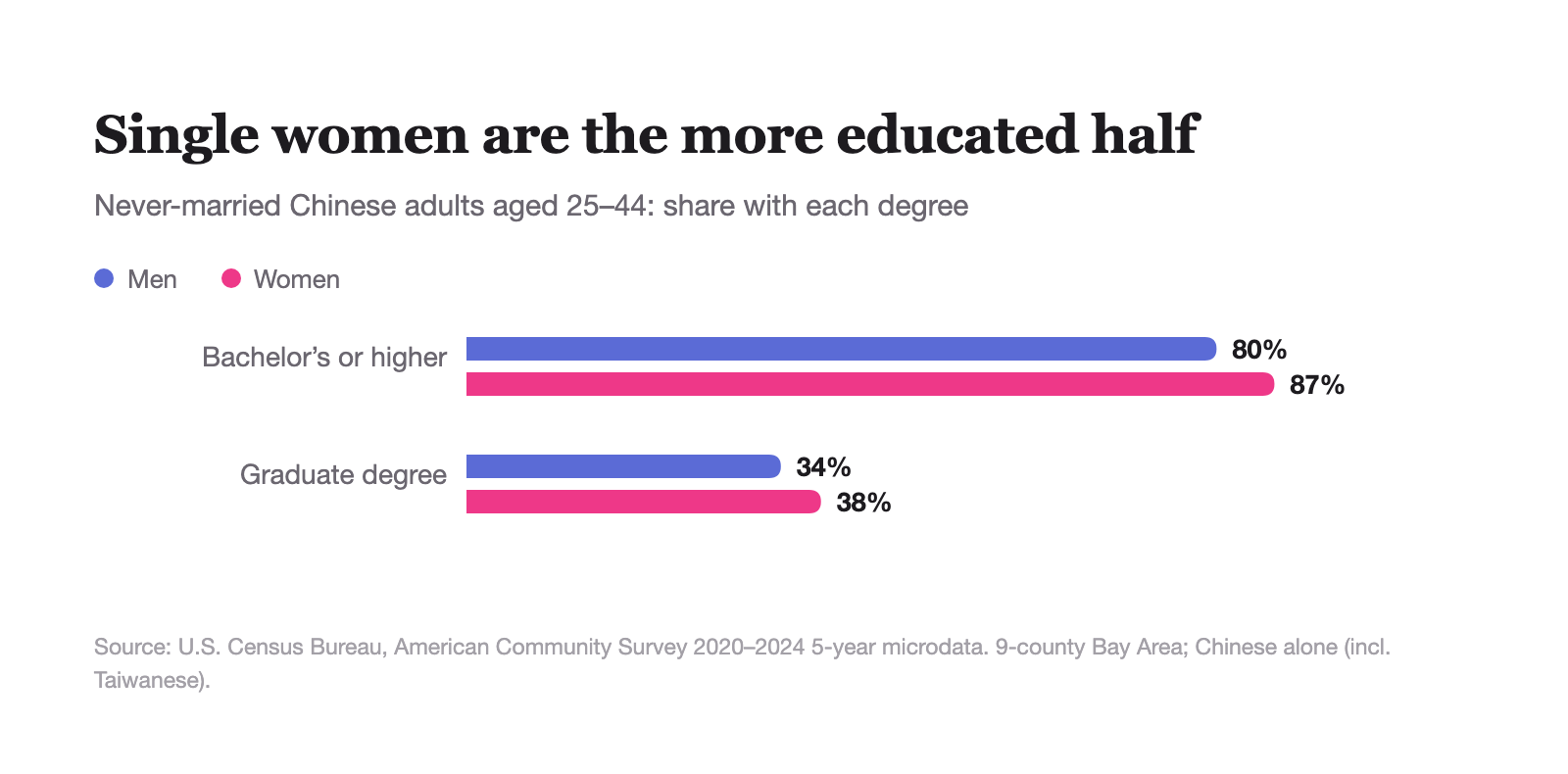
There's a second imbalance hiding underneath. Single women are the more educated half of the market: 87% hold a bachelor's degree or higher, versus 80% of single men, and 38% have a graduate degree versus 34%. If you've ever heard the line "women want to date up," the Bay Area math makes that harder for everyone — the most educated singles here are disproportionately women.
4. Age 45 Is Where the Ratio Flips
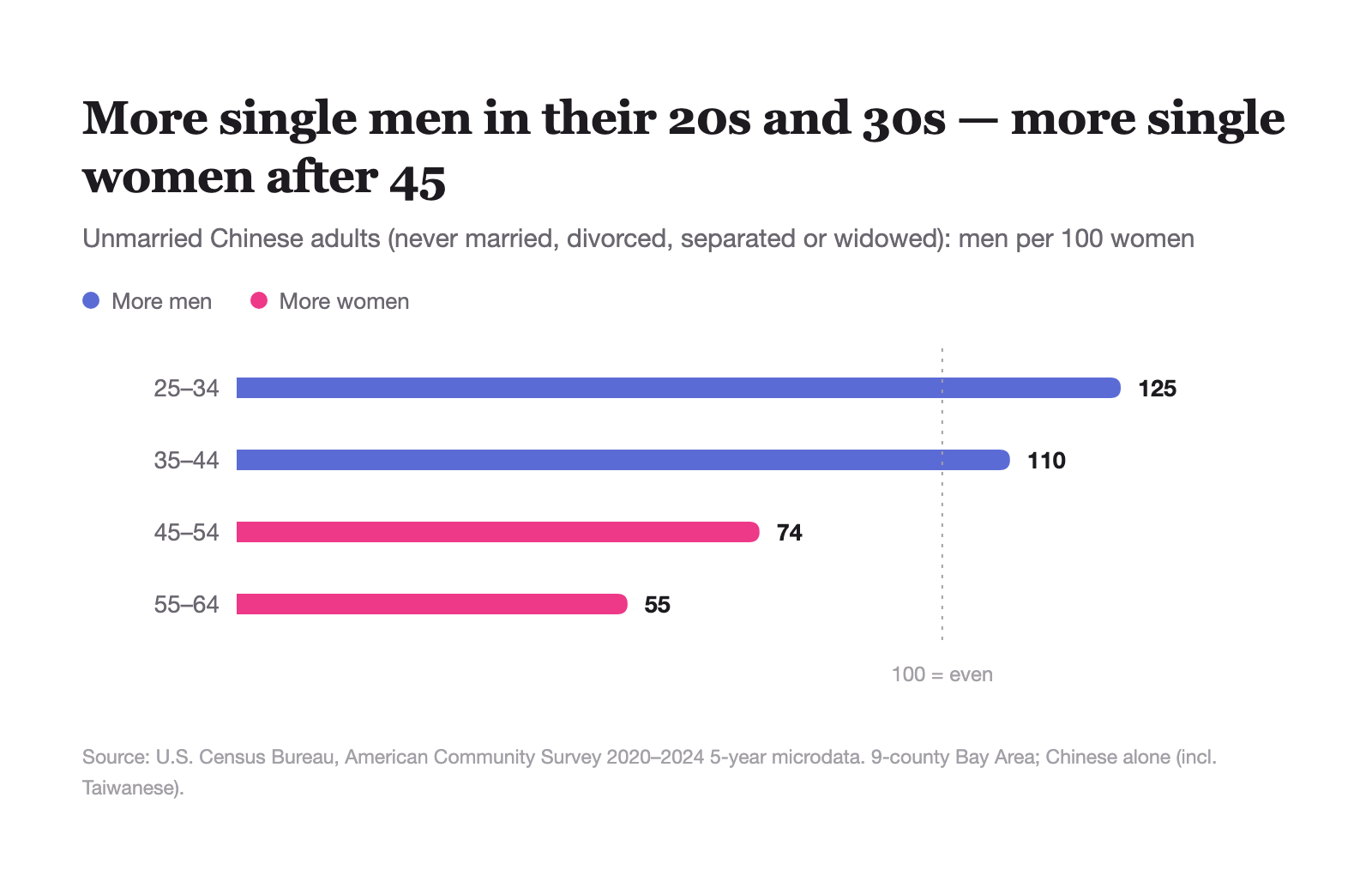
The male surplus doesn't last. Among unmarried Chinese adults:
- 25–34: 125 men per 100 women
- 35–44: 110
- 45–54: 74
- 55–64: 55
Somewhere in the mid-40s, the market tips the other way. Among divorced, separated and widowed adults aged 25 to 64, women outnumber men about two to one. If you're dating again after a divorce, the Bay Area looks very different from the one your younger coworkers describe.
For context, none of this is unique to Chinese Americans. Across all races, the Bay Area's never-married 25-to-44 population runs about 129 men per 100 women. Tech shapes everyone's dating pool here.
5. On the Apps: Do Engineers Actually Get More Likes?
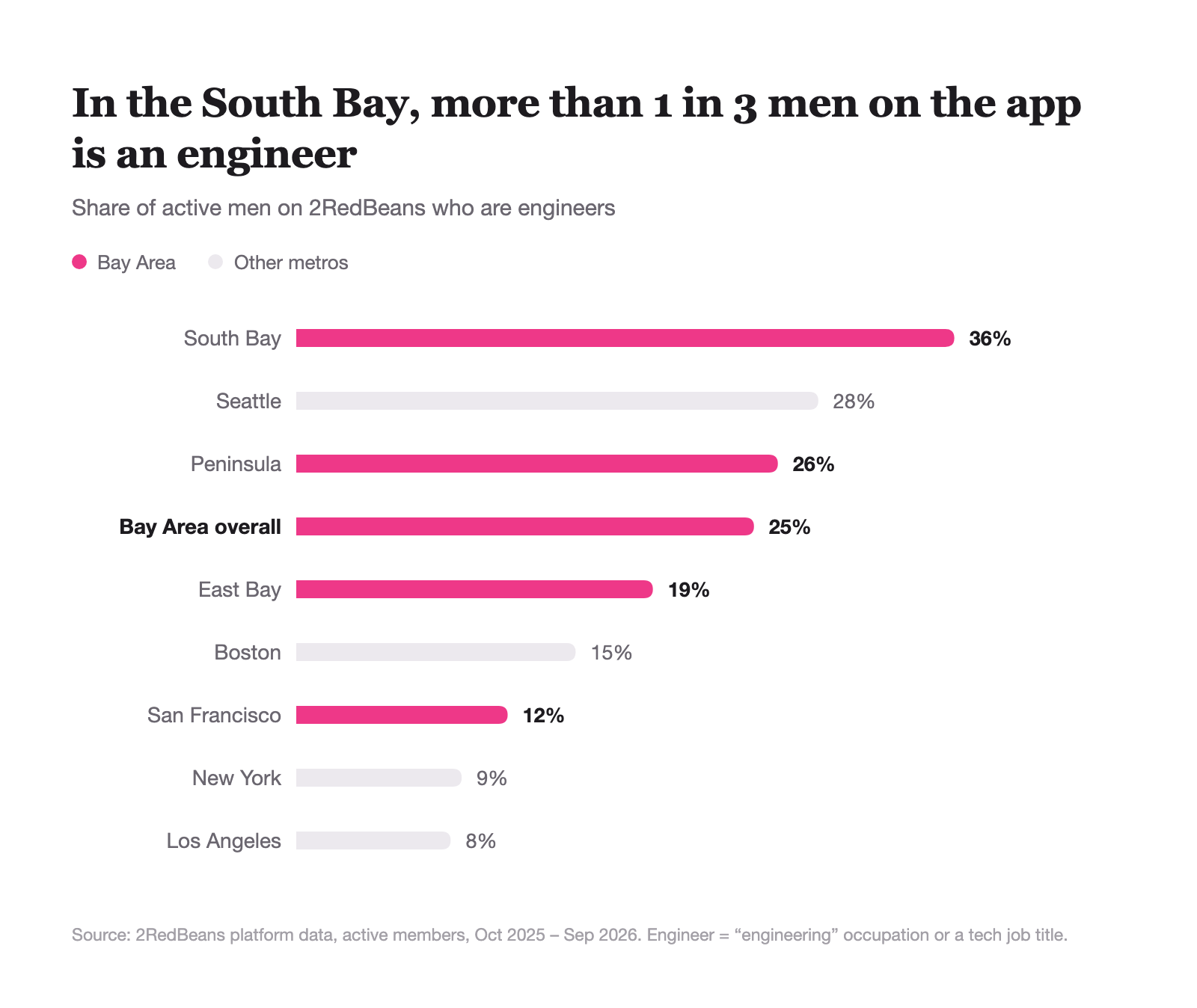
The Census tells you who lives here. Platform data tells you who's actually looking — and how people respond to each other. On 2RedBeans over the past 12 months, 25% of active men in the Bay Area listed engineering as their occupation — 36% in the South Bay. In Los Angeles and New York it's 8–9%. A Bay Area man on the app is about three times as likely to be an engineer as a man in LA.
To measure popularity fairly, we didn't count total likes. Total likes mostly measure how many people saw your profile, and that depends on how active you are and how complete your profile is. Instead we used like rate: of the women who viewed a man's profile, what share sent a like. We compared only men with an approved photo and a stated occupation.
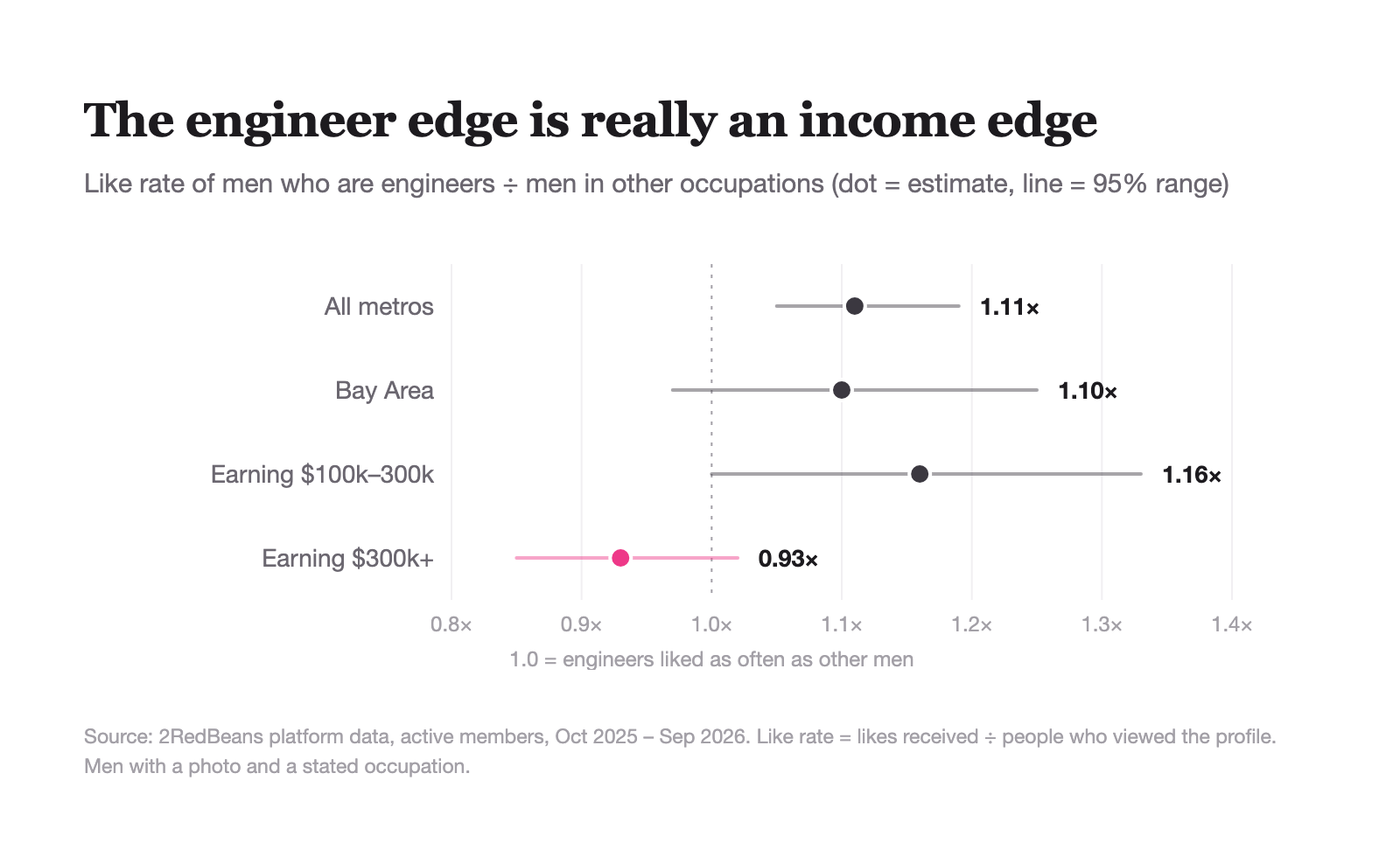
The result: engineers get liked about 10% more often per view than men in other occupations. A real edge, but a modest one.
Then we split by income, and the edge almost disappeared. Among men earning $100k–$300k, engineers still do a bit better. But among men earning $300k or more, engineers are liked no more often than other high earners — slightly less, in fact (0.93×, within the margin of error).
That's the key finding. On a dating profile, "engineer" works mostly as a signal of stable, high income. When the income is already on the table, the job title adds nothing. And in the South Bay, where engineers are the default, being one doesn't make you stand out.
6. Height and Income Matter Far More Than the Job Title
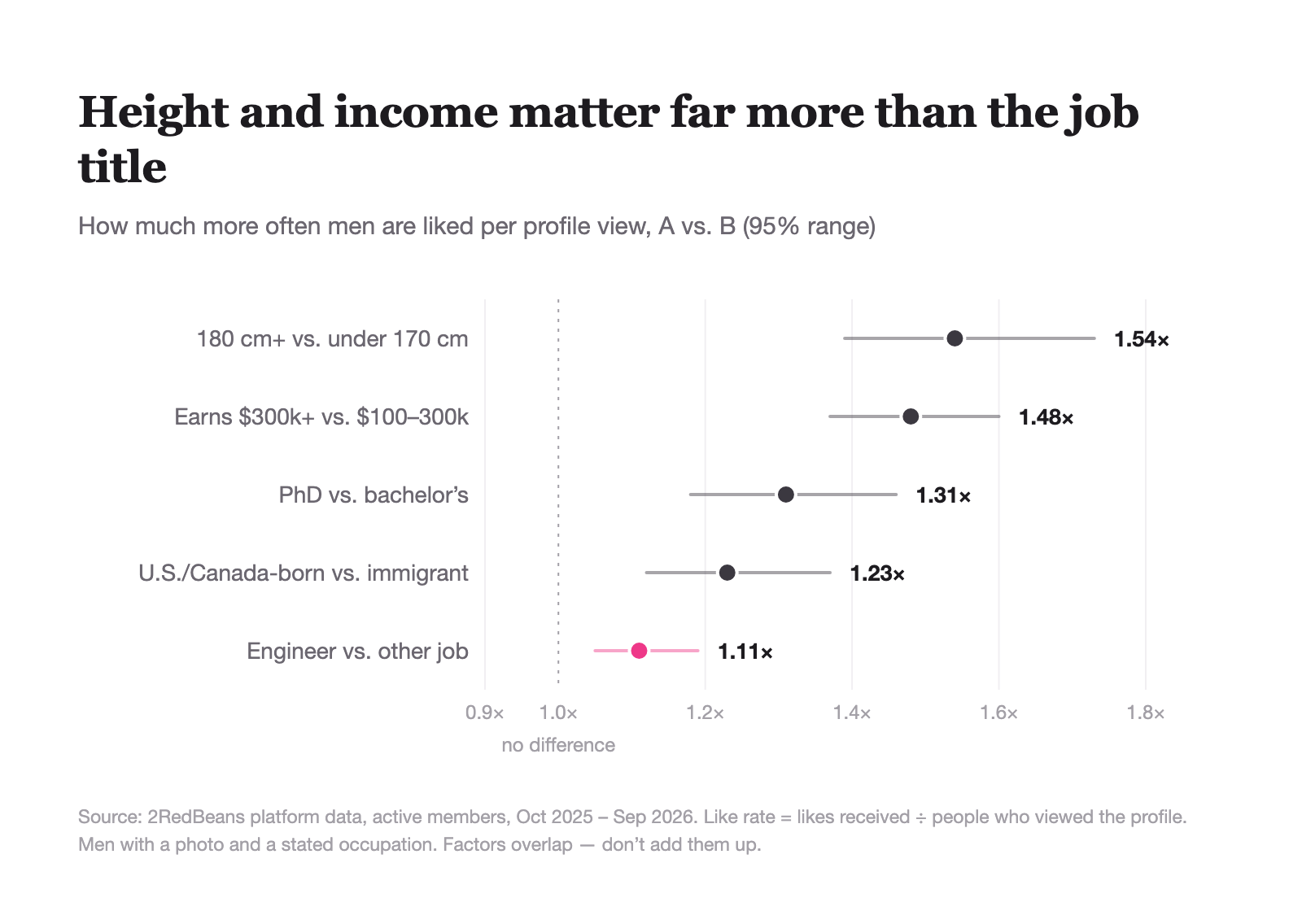
If the job title isn't doing much, what is? Comparing men's like rates across profile traits:
| Men: A vs. B | How much more often A is liked per view |
|---|---|
| 180 cm (5'11") or taller vs. under 170 cm (5'7") | 1.54× |
| Earns $300k+ vs. $100k–$300k | 1.48× |
| PhD vs. bachelor's | 1.31× |
| Born in the U.S. or Canada vs. immigrant | 1.23× |
| Engineer vs. other occupation | 1.11× |
These traits overlap — engineers skew higher-income, for one — so don't add the multipliers together. But the ranking is clear: the boost from height or income is about five times the boost from the job title.
And one factor dwarfs all of them: men without an approved profile photo receive almost no likes at all. Before you worry about how your job reads, make sure you're visible.
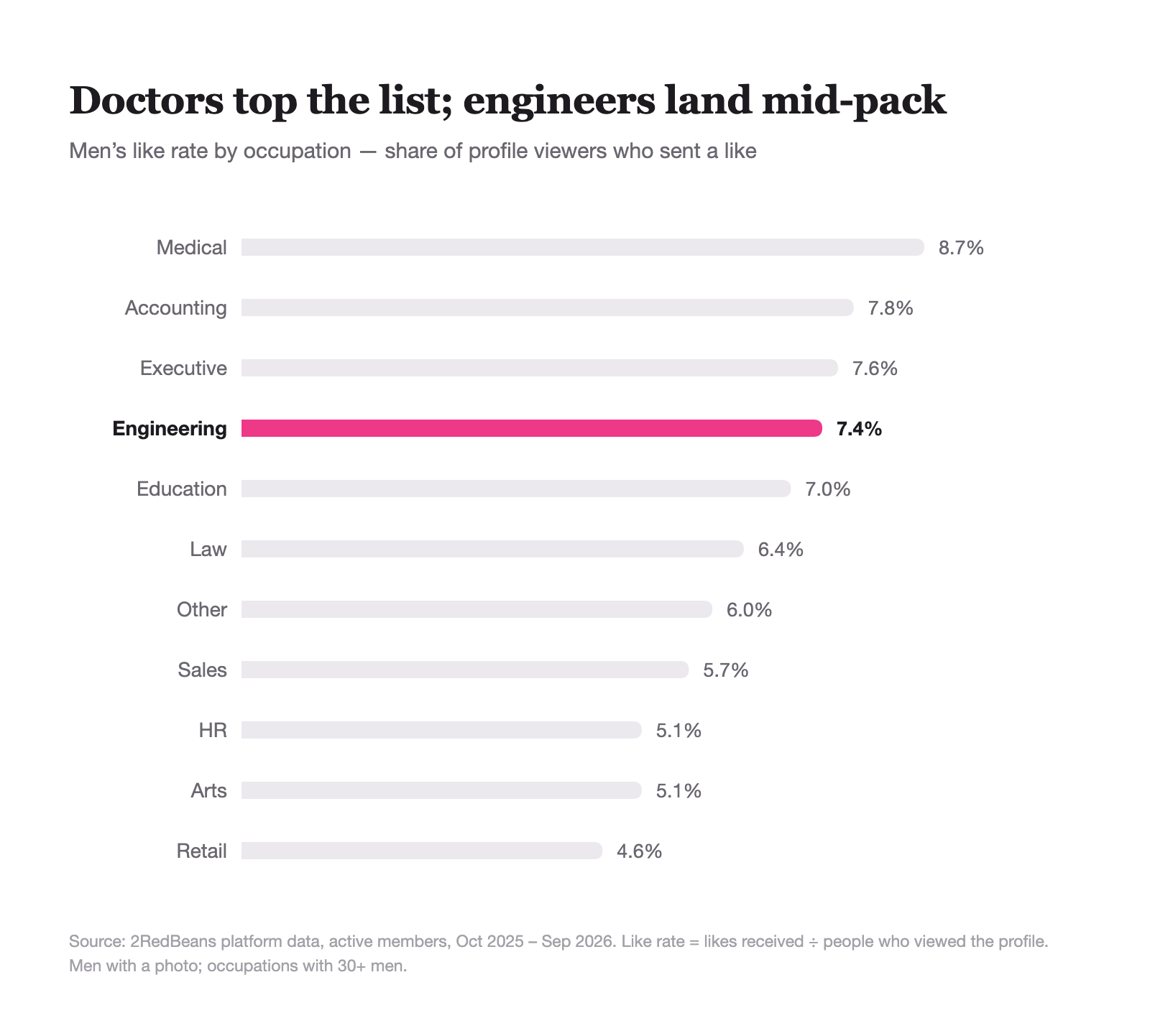
Broken out by occupation, medical professionals top the list (8.7% like rate), followed by accounting, executives and then engineering (7.4%) — solidly above average, but mid-pack among professional jobs. Retail, arts and HR sit at the bottom, around 5%.
What about women who are engineers? Their like rate is slightly lower than women in other professions (about 0.94×), though the gap is small enough that it could be noise. The engineer label doesn't seem to help women — or hurt them much.
7. Almost Nobody Searches by Job Title
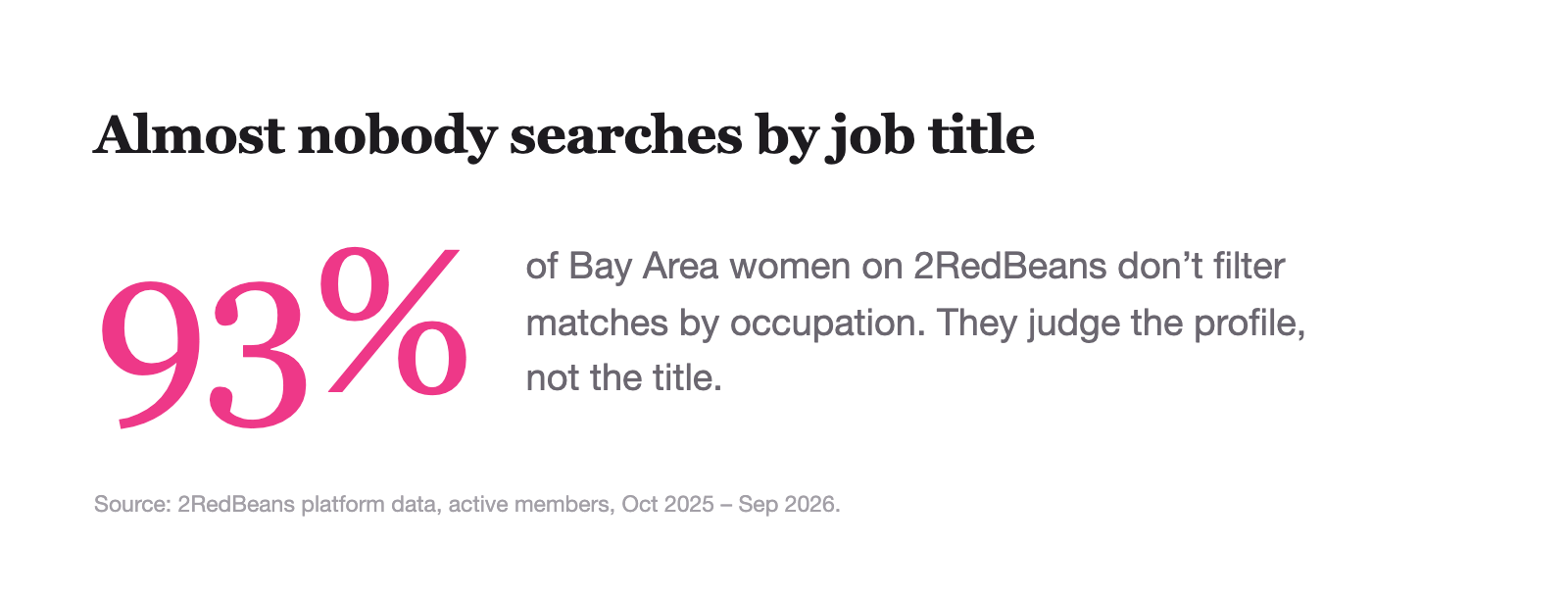
Here's a detail that reframes the whole question. Only 7% of Bay Area women on the platform set an occupation filter when searching. The other 93% aren't screening for engineers — or screening them out. They're reacting to the profile in front of them: the photos, the height, the education, the way someone describes his life.
8. Bay Area Men Are in Demand — Just Not for the Reason They Think
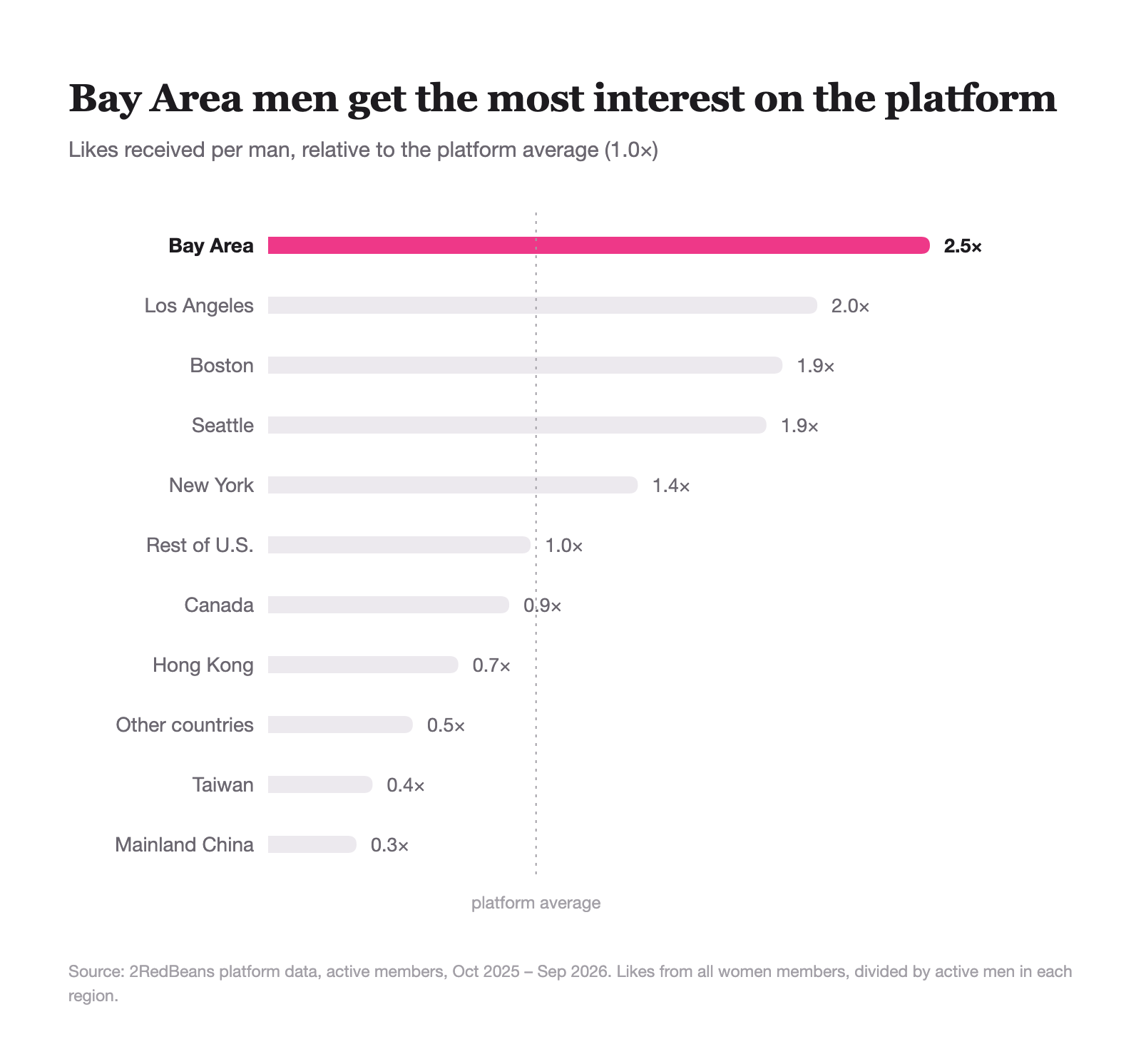
Despite the lopsided local ratio, Bay Area men are the most-liked men on the platform: per man, they receive about 2.5 times the platform average — ahead of Los Angeles (2.1×), Boston and Seattle (1.9×) and New York (1.4×). Interest in Bay Area men comes from women members well beyond the Bay itself.
So the ratio is tough, but the attention is there. The competition isn't for visibility — it's for being memorable among a hundred profiles that all say "software engineer."
9. A Bay Area Dating Profile Checklist
Save this one.
For men in tech:
- Say what you build, not just your title. "I work on the maps team — basically I make sure you don't miss your exit" beats "SWE @ FAANG" every time.
- Lead with one specific thing about your life outside work. A trail you hike, a dish you've perfected, a band you'll drive to Sacramento for. Specific beats impressive.
- Get your photos approved before anything else. At least one clear face shot, one full-length shot, one photo that isn't at a desk or a conference. No approved photo means you're effectively invisible.
- List your height accurately. It's one of the strongest signals in the data, and rounding up only backfires on the first date.
- Don't hide the stability; show it without the brag. "Settled in San Jose, own a place with a garden I'm slowly ruining" says more than a salary band.
- Widen your radius. If you're in the South Bay, include the Peninsula and San Francisco. A 30-minute drive moves you from a 144:100 market toward 100:100.
For women:
- You have more options than you think — so be specific about what you want. In a market with more men, a clear profile filters for you.
- Look past the job title. "Engineer" tells you less than you'd think. Ask what they do with their weekends.
- If you're in the Peninsula or San Francisco, consider the South Bay. That's where the surplus is.
About the Data
- Census: U.S. Census Bureau, American Community Survey 2020–2024 5-year Public Use Microdata (sex ratios, education, occupation) and 2024 1-year Selected Population Profiles; tables B02015 and B01003 for county populations. Nine-county Bay Area; "Chinese" = Chinese alone, including Taiwanese. Unmarried = never married, divorced, separated or widowed.
- 2RedBeans platform data: anonymized, aggregated activity of active members from October 2025 to September 2026. The Bay Area is defined by ZIP code across the same nine counties. Like rate = likes received ÷ distinct members who viewed the profile, counting only opposite-sex interactions from genuine (non-spam) accounts. Comparisons use men with an approved photo and a stated occupation; ranges are 95% bootstrap intervals. We report ratios and percentages only.
If your profile reads like everyone else's in the South Bay, a second pair of eyes helps. Our Profile Concierge service works one-on-one with you on photos, wording and positioning, so your profile says something a job title can't.
FAQ
Q: What is the ratio of single Chinese men to women in the Bay Area?
According to the American Community Survey (2020–2024), among unmarried Chinese adults aged 25 to 44 in the nine-county Bay Area, there are about 121 men for every 100 women — roughly 62,000 men and 51,000 women. Among those who have never married, the ratio is about 125 to 100.
Q: Where in the Bay Area is the gender ratio most uneven?
The South Bay. In Santa Clara County, unmarried Chinese adults aged 25 to 44 number about 144 men for every 100 women. The East Bay is about 118, San Francisco about 111, and San Mateo County (the Peninsula) is roughly even at 98.
Q: Is the Bay Area's gender imbalance caused by the tech industry?
Largely, yes. Among never-married Chinese adults aged 25 to 44, software developers number about 235 men per 100 women, and all computer and engineering jobs about 208. Outside those occupations, the ratio is about 103 to 100 — essentially balanced.